
The 2025 Mars Innovation Challenge
Submissions Close May 9, 2025
2025 Mars Innovation Challenge Resource Page
For support or assistance please contact Explore Mars at:
mission - control @ exploremars.org
We are thrilled by the overwhelming brilliance of the submissions received for the Mars Innovation Challenge. The creativity and innovation demonstrated have been truly inspiring.
To ensure each entry receives the thorough evaluation it deserves, we are extending the judging period. Winners will now be announced shortly after June 15th.
Thank you for your innovative and exciting ideas. We are confident that your contributions will play a significant role in shaping the future of human exploration on Mars.
Overview:
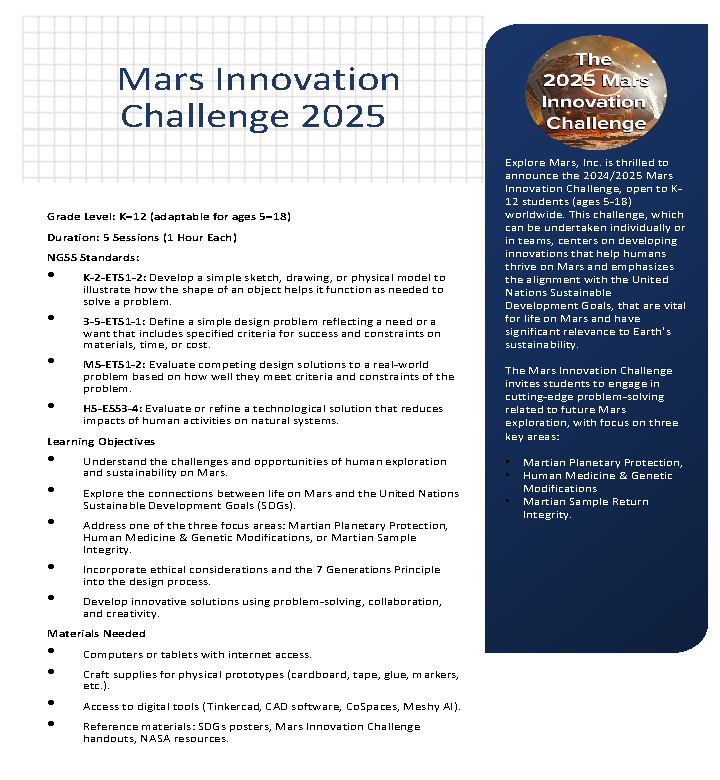
Explore Mars, Inc. is thrilled to announce the 2024/2025 Mars Innovation Challenge, open to K-12 students (ages 5-18) worldwide. This challenge, which can be undertaken individually or in teams, centers on developing innovations that help humans thrive on Mars and emphasizes the alignment with the United Nations Sustainable Development Goals, that are vital for life on Mars and have significant relevance to Earth’s sustainability.
The Mars Innovation Challenge invites students to engage in cutting-edge problem-solving related to future Mars exploration, with focus on three key areas:
- Martian Planetary Protection,
- Human Medicine & Genetic Modifications
- Martian Sample Return Integrity.
Participants should also incorporate exploration ethics and the 7 Generations Principle. This Native American principle urges us to consider the long-term impacts of our actions on future generations—specifically, how today’s decisions will affect people living seven generations from now.
The challenge, in collaboration with Thrive Games and their blockchain game THRIVE ON MARS, encourages participants to be creative and practical, addressing real challenges for future Mars inhabitants. In combination with a $1500 cash award, the winning innovation will be featured in the THRIVE ON MARS game, offering an exciting opportunity for young innovators to impact both space exploration and global sustainability!
1
Planetary Protection
Planetary Protection
- Planetary Protection
-
- Objective: Ensure that human exploration of Mars does not irreversibly impact its natural environment and further consider upon a Mars sample return how do we protect Earth from any microorganisms or unknown bacteria from Mars does not affect or impact the life and environment of Earth. Participants will explore ways to prevent contamination between Earth and Mars while allowing for scientific exploration.
- Research Focus:
-
- Survival and potential evolution of Earth microorganisms in Martian conditions
- Development of efficient sterilization techniques for spacecraft and habitats
- Long-term effects of human activities on the Martian environment
- Cross-contamination prevention strategies between Earth and Mars
- Ethical considerations of altering Martian environments
- Legal frameworks for planetary protection in commercial space activities
- Balancing exploration with contamination prevention in international law
Deliverable: A comprehensive plan or prototype to mitigate contamination risks while advancing exploration goals.
Resources and Tools:
-
- NASA Office of Planetary Protection:
https://planetaryprotection.nasa.gov
Provides comprehensive resources on planetary protection policies, current research, and ongoing efforts to prevent biological contamination between Earth and other celestial bodies. - COSPAR Planetary Protection Policy:
https://cosparhq.cnes.fr/
The Committee on Space Research (COSPAR) provides internationally recognized planetary protection guidelines. Their policy documents are a key resource for understanding the global standards in space exploration.
- NASA Office of Planetary Protection:
- Spacecraft Sterilization Techniques:
-
- NASA's Jet Propulsion Laboratory Sterilization Processes
https://www.jpl.nasa.gov/
JPL provides detailed information about the sterilization techniques used in planetary missions, such as the Viking Program. Learn more about the methods to reduce microbial contamination.
- NASA's Jet Propulsion Laboratory Sterilization Processes
- International Council for Science (ICSU) – Planetary Science Programs
https://www.icsu.org/
ICSU coordinates planetary protection standards across nations to ensure scientific rigor in space exploration. Explore their publications and policy resources.
Interactive Tools:
- Loopy by Nicky Case (for modeling feedback loops and systems):
https://ncase.me/loopy/
Participants can use Loopy to model interconnected systems that simulate contamination or planetary protection feedback loops. - PHET Interactive Simulations – Space Exploration Simulations
https://phet.colorado.edu/en/simulations
PHET offers interactive simulations related to physics and planetary science, useful for visualizing contamination risks or sterilization methods. - SIMOC (Scalable, Interactive Model of an Off-world Community) is a highly customizable and interactive simulator designed to model a sustainable human habitat on Mars. Developed in collaboration with the National Geographic Society and Arizona State University, SIMOC allows users to explore how different variables (such as energy, water, food, and oxygen) interact to create a livable environment on another planet.
Key Features:
- Simulation of Life Support Systems: SIMOC allows users to experiment with various life support systems, including food production, water recycling, and oxygen generation, and observe how these systems interact under different environmental conditions.
- Customizable Parameters: Users can adjust factors like the size of the habitat, the number of inhabitants, types of plants grown, and the efficiency of recycling systems, making it a great educational tool for exploring how to build sustainable colonies on Mars or other off-world environments.
- Real-time Feedback: As users manipulate the variables, they can see the impact of their decisions on the overall sustainability of the habitat, offering a realistic view of the challenges involved in space colonization.
SIMOC offers a hands-on learning experience for students, educators, and researchers interested in the complexities of building human habitats in space.
For more information, you can explore SIMOC directly at https://ngs.simoc.space/.
2
Human Medicine & Genetic Modifications
Human Medicine & Genetic Modifications
- Human Medicine & Genetic Modifications
-
- Objective: Address the physiological challenges humans will face during extended stays on Mars, including how we can adapt the human body to Martian conditions.
- Research Focus:
-
- Genetic modifications to enhance human resilience in low-gravity, non-terrestrial environments
- Ethical considerations in modifying human biology for space survival
- Mitigating the effects of radiation and isolation on long-term health
- Innovations in medical technologies for remote diagnostics and care
- Applicability of transhumanism approach for planetary exploration
Deliverable: A proposal outlining medical or genetic solutions to key challenges faced by humans on Mars, considering both the science and ethics of human modification.
Resources and Tools:
- NASA’s Human Research Program (HRP):
https://www.nasa.gov/hrp
NASA’s HRP provides critical research on how space environments affect human physiology, including radiation exposure, bone density loss, and genetic risks. It’s a great resource for understanding the health risks of long-term space missions. - Human Genetic Modifications for Space Exploration (National Academies):
https://www.nationalacademies.org/
The National Academies of Science, Engineering, and Medicine provide reports and research on the ethics, risks, and benefits of using genetic modifications to enhance human resilience for space exploration. - Radiation Exposure on Mars: Research and Guidelines (ESA):
https://www.esa.int/
The European Space Agency offers publications about space radiation exposure and its impact on astronaut health. Their research covers shielding techniques and genetic solutions to mitigate radiation damage. - Center for the Study of Extraterrestrial Life – Space Medicine Research:
https://csel.space/
Explore ongoing research in space medicine, with a focus on human health challenges in extraterrestrial environments, including isolation, psychological effects, and the physiological toll of living on Mars.
Interactive Tools:
- NIH Human Genome Research Institute – Ethical Considerations for Genetic Modifications:
https://www.genome.gov/
This resource offers ethical guidelines for genetic modifications, focusing on the balance between scientific innovation and human rights.
International Space University – Space Medicine and Biology Courses:
https://www.isunet.edu/
ISU offers open educational resources and courses on space medicine, genetics, and physiology, tailored to address the unique challenges of human health in space.
3
Sample Integrity
Sample Integrity
- Sample Integrity
-
- Objective: Ensure that Mars samples brought back to Earth by NASA Mars Sample Return Program and other missions retain their scientific integrity while preventing any potential cross-contamination.
- Research Focus:
-
- Development of containment technologies for Martian samples
- Preservation of sample purity and integrity in different environments (Earth, space, and Mars)
- Innovations in safe transport and storage of extraterrestrial materials
- Balancing scientific inquiry with planetary contamination prevention
Deliverable: A design or protocol for safe sample handling, transportation, and analysis that preserves sample integrity while balancing scientific inquiry with planetary contamination prevention.
Resources and Tools:
- Mars Sample Return Program by NASA and ESA:
https://mars.nasa.gov/msr/
Explore NASA and ESA’s Mars Sample Return program for in-depth research on the logistics, technology, and protocols involved in preserving the integrity of Martian samples during transportation to Earth. - Containment and Planetary Protection (Sample Return Missions):
https://www.nasa.gov/mission_pages/mars/news/msr_overview.html
This NASA resource provides information on containment technologies and planetary protection measures specific to sample return missions. - ISRU (In-Situ Resource Utilization) and its Role in Sample Integrity:
https://www.nasa.gov/exploration/technology/isru/
Understand the role of ISRU in minimizing contamination risks by using local resources for sample preservation and analysis on Mars before returning them to Earth. - Lunar and Planetary Institute – Sample Handling and Analysis:
https://www.lpi.usra.edu/
The Lunar and Planetary Institute provides access to publications and research about handling extraterrestrial materials, including containment strategies.
Interactive Tools:
- SageModeler (for systems thinking in sample integrity):
https://concord.org/sagemodeler/
SageModeler allows participants to create models of how to maintain sample integrity while minimizing contamination throughout the collection and return phases.
Planetary Society’s Mars Sample Return Overview:
https://www.planetary.org/explore/space-topics/mars-sample-return
Offers a comprehensive overview of Mars sample return missions, with articles and insights on the importance of preventing cross-contamination.
Teacher’s Guide to Facilitating the Mars Innovation Challenge
Purpose of the Challenge: The Mars Innovation Challenge engages students in solving real-world problems related to Mars exploration, focusing on three key areas: Planetary Protection, Human Medicine & Genetic Modifications, and Sample Integrity. The challenge promotes critical thinking, innovation, and ethical decision-making.
Teacher’s Role: Your role as a facilitator is to guide students through the research process, help them develop their ideas, and encourage collaboration. You will help structure their projects, offer feedback, and ensure they stay on track throughout the challenge.
Step-by-Step Facilitation Plan
- Kickoff and Introduction:
- Objective: Set the tone and get students excited about the challenge.
- Activity: Start by introducing the three challenge areas and the ethical principles (7 Generations Principle, exploration ethics). Use videos, articles, or a brief presentation to explain the relevance of Mars exploration.
- Materials: Videos from NASA’s Mars exploration missions, articles on planetary protection, or ethics in space.
- Topic Selection:
- Objective: Help students choose a challenge area they are passionate about.
- Activity: Break students into small groups and assign each group to one of the three areas: Planetary Protection, Human Medicine & Genetic Modifications, or Sample Integrity. Allow them to explore the resources (e.g., links to NASA and other educational materials) to help them understand the problem they will be tackling.
- Discussion Points:
-
-
- How does this challenge affect the future of Mars exploration?
-
- How do humans discover and create new worlds for themselves?
-
-
- What ethical considerations need to be made?
- How can science and technology help solve these issues?
-
- How do humans deal with unknown?
- Research and Exploration:
-
- Objective: Encourage students to dive deeper into their chosen topics.
- Activity: Provide a list of curated resources (such as those mentioned earlier) and guide students in researching their challenge area. Encourage them to take notes, identify key issues, and start formulating potential solutions.
- Tips for Success:
-
- Have students review scientific literature or watch educational videos.
- Organize brainstorming sessions where groups discuss their findings.
- Encourage students to consider both the technical and ethical aspects of their solution.
- Ethical Considerations:
-
- Objective: Teach students the importance of ethics in exploration and innovation.
- Activity: Introduce the 7 Generations Principle and exploration ethics. Ask students to discuss how their proposed solution might impact future generations.
- Discussion Prompts:
-
- How will your solution impact future humans on Mars?
- What unintended consequences could arise from your innovation?
- How can you design your solution to benefit both current and future generations?
- Prototyping and Developing Ideas:
- Objective: Help students start creating tangible solutions.
- Activity: Guide students through the process of developing a prototype, plan, or concept. Depending on their challenge area, this could include designing technology, proposing new methods, or drafting a framework for policy.
- Resources: Encourage students to use interactive tools like PHET Simulations or SageModeler to visualize their solutions.
- Pitch Deck Preparation:
- Objective: Prepare students to present their ideas effectively.
- Activity: Introduce the concept of a pitch deck and how it’s used to communicate ideas clearly and persuasively (detailed guide below).
- Materials: Examples of pitch decks from tech companies or NASA proposals. Ensure students have access to a template they can use for their own decks.
- Practice and Presentation:
-
- Objective: Ensure students are ready to present their final ideas.
- Activity: Host practice sessions where students present their pitch decks and get feedback from their peers and teachers. Offer constructive feedback, especially on clarity, presentation skills, and the feasibility of their ideas.
- Tips:
-
- Encourage students to practice their presentations multiple times.
- Offer guidance on public speaking, body language, and how to handle questions from the audience.
Guide to Creating a Pitch Deck for the Mars Innovation Challenge
A pitch deck is a concise, engaging presentation designed to communicate an idea or proposal effectively. For this challenge, the pitch deck should present the students’ innovative solution to one of the challenge areas.
Structure of the Pitch Deck:
- Title Slide:
- Contents:
-
- Title of the project
- Student group names
- School or class information
- Tip: Make this slide visually appealing, perhaps using imagery related to Mars or space exploration.
- Problem Statement:
- Contents:
-
- Clearly define the problem your solution addresses (e.g., planetary contamination, human health challenges, sample preservation).
- Highlight why this problem is important for future Mars exploration.
- Tip: Use statistics or quotes from reputable sources to emphasize the scale and importance of the problem.
- Proposed Solution:
- Contents:
-
- Briefly describe the innovation or idea.
- Explain how it solves the identified problem.
- Discuss the core technologies, methods, or approaches involved.
- Tip: Keep this explanation clear and concise, using visuals where possible (e.g., diagrams, flowcharts).
- Impact and Feasibility:
- Contents:
-
- Discuss how your solution could be implemented on Mars.
- Describe the long-term impact, considering both technical and ethical aspects.
- Address potential challenges or risks.
- Tip: Incorporate the 7 Generations Principle by explaining how the solution benefits both current and future generations.
- Ethical Considerations:
- Contents:
-
- Reflect on the ethical implications of your solution.
- How does it balance scientific advancement with planetary protection?
- Consider any potential negative consequences and how you plan to mitigate them.
- Tip: This slide is where you integrate exploration ethics into your solution.
- Budget and Resources:
- Contents:
-
- Provide an outline of the resources required to develop and implement your solution (e.g., funding, technology, personnel).
- Mention any interactive tools or partnerships you plan to leverage.
- Include a “working budget” that shows how resources will be allocated.
- Tip: You don’t need to be exact with numbers but focus on the types of resources needed.
- Call to Action/Next Steps:
- Contents:
-
- What are the next steps to bring your idea to life?
- If this were implemented in a real-world scenario, what would be needed (e.g., additional research, testing, funding)?
- Tip: Encourage the audience to support the idea, whether that’s through collaboration, further research, or funding.
- Highlight the unanswered questions that came up as you are working on the project
- Identify whether you have any idea on how to approach them or not
- Propose your suggestions on how to act when you deal with the unknown
- Conclusion:
- Contents:
-
- Summarize your solution and its key benefits.
- Reaffirm why your idea is necessary for the future of Mars exploration.
- Tip: Keep it brief and end on an inspiring note, emphasizing the future impact.
Additional Tips for Pitching:
- Be clear and concise: Make sure every slide has a clear purpose, and avoid overwhelming the audience with too much information.
- Use visuals effectively: Pictures, diagrams, and infographics can help convey complex ideas quickly.
- Practice your delivery: Ensure that the presentation is well-rehearsed, and practice answering potential questions.
- Keep the focus on the solution: Always tie your points back to the problem you’re solving and how your solution will make a difference.